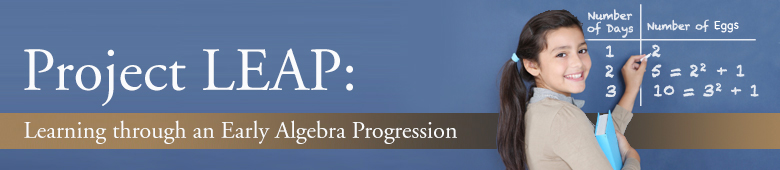

Teaching and learning algebra has undergone a critical transformation in the U.S. over the last two decades. Recognizing that historical paths to algebra have been largely unsuccessful in terms of students’ achievement, mathematics education scholars have increasingly advocated that algebra be re-conceptualized in school mathematics as a longitudinal, Grades K–12 strand of thinking. In particular, scholars advocate that students have long-term, sustained algebra experiences in school mathematics, beginning in the elementary grades, that build their natural, informal intuitions about structure and relationships into formalized ways of mathematical thinking.
Project LEAP is a series of projects focused on the development, implementation, and testing of a sustained and comprehensive approach to early algebra:
Developing Algebra-Ready Students for Middle School: Exploring the Impact of Early Algebra (2009-2013)
The Impact of Early Algebra on Students’ Algebra-Readiness (2012-2017)
Project LEAP: Extending a Grades 3–5 Early Algebra Learning Progression into Grades K–2 (2017-2021)
Building a Grades K–2 Early Algebra Learning Progression for Diverse Populations (2017-2020)
Developing Algebra-Ready Students for Middle School: Exploring the Impact of Early Algebra (2009-2013)
Funded by the National Science Foundation DRL-1207945
In this first LEAP project, we constructed an Early Algebra Learning Progression [EALP] consisting of a curricular framework and progression developed by coordinating research, curricular, and mathematical perspectives; a Grades 3–5 instructional sequence based on the framework and progression; associated assessments; and levels of sophistication describing strategies observed in children’s mathematical work. We also conducted a preliminary study to examine the impact of our EALP’s instructional intervention as measured by our assessments and found that students who experienced the early algebra intervention outperformed comparison students on our early algebra assessment and were more apt by posttest to use algebraic strategies to solve problems.
Principal Investigators
Maria L. Blanton, TERC
Eric Knuth, University of Wisconsin-Madison
Project Staff
Angela Murphy Gardiner, TERC
Isil Isler, University of Wisconsin-Madison
Jee-Seon Kim, University of Wisconsin-Madison
Tim Marum, TERC
Ana Stephens, University of Wisconsin-Madison
Advisory Board
Tom Carpenter, University of Wisconsin-Madison
Barbara Dougherty, University of Missouri
Amy Ellis, University of Wisconsin-Madison
Carolyn Kieran, Université du Québec à Montréal
Analúcia Schliemann, Tufts University
The Impact of Early Algebra on Students’ Algebra-Readiness (2012-2017)
Funded by National Science Foundation DRL-1219605/06
In our second LEAP project, we used the instructional sequence and grade-level assessments developed in the first project to conduct a small-scale longitudinal study to measure the impact of our comprehensive, sustained Grades 3–5 early algebra intervention on students' algebra understanding in elementary grades and their algebra readiness in middle school. The project used a quasi-experimental design to compare the performance of students who received our early algebra intervention to students who receive more traditional elementary grades instruction. We found that intervention students outperformed control students on post-assessments at each of Grades 3–5 and were more able to flexibly interpret variable in different roles and use variable notation in meaningful ways in different mathematical contexts.
Principal Investigators
Maria L. Blanton, TERC
Eric Knuth, University of Wisconsin-Madison
Ana Stephens, University of Wisconsin-Madison
Project Staff
Angela Murphy Gardiner, TERC
Rachel Hayes, TERC
Isil Isler, University of Wisconsin-Madison
Hannah Kang, University of Wisconsin-Madison
Jee-Seon Kim, University of Wisconsin-Madison
Susanne Strachota, University of Wisconsin-Madison
Advisory Board
Bárbara Brizuela, Tufts University
Tom Carpenter, University of Wisconsin-Madison
Daniel Chazan, University of Maryland
David Yopp, University of Idaho
The Impact of a Teacher-Led Early Algebra Intervention on Children’s Algebra-Readiness for Middle School (2014-2018)
Funded by Institute for Education Sciences R305A140092
This third LEAP project involved scaling up our work to a much larger number of schools and testing the effectiveness of the early algebra intervention when implemented by regular classroom teachers who participated in professional development. Results show that during Grade 3, treatment students, including those in at-risk settings, improved at a significantly faster rate than control students on measures of algebra performance and strategy use and maintained their advantage throughout the intervention.
Principal Investigators
Maria L. Blanton, TERC
Lindsay Demers, TERC
Eric Knuth, University of Wisconsin-Madison
Ana Stephens, University of Wisconsin-Madison
Rena Stroud, Merrimack College
Despina Stylianou, CCNY-CUNY
Project Staff
Angela Murphy Gardiner, TERC
Rachel Hayes, TERC
Isil Isler, University of Wisconsin-Madison
Hannah Kang, University of Wisconsin-Madison
Susanne Strachota, University of Wisconsin-Madison
Advisory Board
Bárbara Brizuela, Tufts University
Heather Hill, Harvard University
Victoria Jacobs, University of North Carolina-Greensboro
Bethany Rittle-Johnson, Vanderbilt University
Project LEAP: Extending a Grades 3–5 Early Algebra Learning Progression into Grades K–2 (2017-2021)
Funded by Institute for Education Sciences R305A170378
The goal of this project is to extend our Grades 3–5 work into the early grades by designing and testing a Grades K–2 early algebra learning progression. This work will include developing an instructional sequence and interview assessments and testing the impact of the instructional sequence on students’ learning. Two classrooms of students will be followed throughout Grades K–2 in a researcher-led intervention. In Year 4, a cross-sectional teacher-led effectiveness study will take place, with one experimental and one control classroom at each grade level.
Principal Investigators
Maria L. Blanton, TERC
Angela Murphy Gardiner, TERC
Eric Knuth, University of Texas at Austin
Ana Stephens, University of Wisconsin-Madison
Rena Stroud, Merrimack College
Project Staff
Rachel Hayes, TERC
Samantha Prough, University of Wisconsin-Madison
Ingrid Ristroph, University of Texas at Austin
Susanne Strachota, University of Wisconsin-Madison
Yewon Sung, University of Wisconsin-Madison
Ranza Veltri Torres, University of Wisconsin-Madison
Advisory Board
Bárbara Brizuela, Tufts University
Susan Jo Russell, TERC
Building a Grades K–2 Early Algebra Learning Progression for Diverse Populations (2017-2020)
Funded by National Science Foundation DRL-1720129
The goal of this project is to extend our Grades 3–5 work into the early grades by designing and testing a Grades K–2 early algebra learning progression and paying particular attention to the needs and experiences of the diversity of learners, including those with math difficulties or disabilities. This work will include developing an instructional sequence and interview assessments, and testing strategies to help a diverse range of students, including examining how mathematical tools mediate students’ algebraic thinking. A cross-sectional researcher-led intervention will take place in one classroom in each of Grades K–2.
Principal Investigators
Maria L. Blanton, TERC
Angela Murphy Gardiner, TERC
Eric Knuth, University of Texas at Austin
Ana Stephens, University of Wisconsin-Madison
Rena Stroud, Merrimack College
Project Staff
Rachel Hayes, TERC
Karisma Morton, University of Texas at Austin
Samantha Prough, University of Wisconsin-Madison
Susanne Strachota, University of Wisconsin-Madison
Yewon Sung, University of Wisconsin-Madison
Ranza Veltri Torres, University of Wisconsin-Madison
Advisory Board
Michael Battista, Ohio State University
Bárbara Brizuela, Tufts University
Susan Jo Russell, TERC
Identifying Effective Instructional Practices that Foster the Development of Algebraic Thinking in Elementary School (2017-2021)
Funded by National Science Foundation DRL-1721192
In this project, we are revisiting the classroom video collected in The Impact of a Teacher-Led Early Algebra Intervention on Children’s Algebra-Readiness for Middle School (2014-2018) with the goals of developing an early algebra classroom observational instrument and identifying instructional practices that are associated with students’ early algebra learning.
Principal Investigators
Eric Knuth, University of Texas at Austin
Maria L. Blanton, TERC
Angela Murphy Gardiner, TERC
Ana Stephens, University of Wisconsin-Madison
Despina Stylianou, CCNY-CUNY
Project Staff
Ryan Gertenbach, University of Texas at Austin
Rachel Hayes, TERC
Karisma Morton, University of Texas at Austin
Ingrid Ristroph, University of Texas at Austin
Amy Velchoff, University of Texas at Austin
Advisory Board
Hala Ghousseini, University of Wisconsin-Madison
E. Paul Goldenberg, Education Development Center
Victoria Jacobs, University of North Carolina-Greensboro